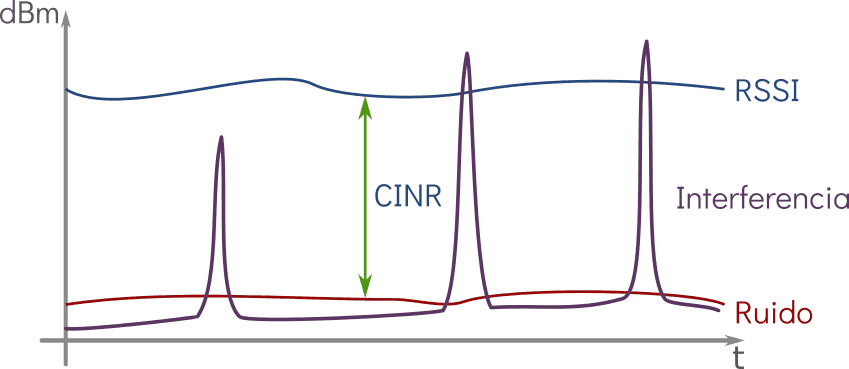
CINR stands for Carrier-to-Interference-plus-Noise Ratio and is a measure of the quality of a radio signal in a wireless communications system. It refers to the relationship between the useful signal (the information to be transmitted) and the total noise (including interference from other nearby radio signals).
Let's give an example: imagine that you are at a party and you want to talk to a friend. The useful signal would be your voice, while the total noise would be the background noise of the party (music, laughter, etc.). CINR is a measure of how clearly you can hear your friend's voice compared to background noise.
If the ratio is high (i.e., the CINR is high), you can probably hear your friend clearly. If the ratio is low (i.e., the CINR is low), you may have difficulty hearing your friend due to background noise.
In the case of Mimosa radios, CINR is a measure of the signal quality on the wireless link and is used to adjust the transmission rate (data transmission speed) to ensure reliable and efficient transmission.